


Agility Research & Strategy | September 8, 2026

There is a version of this map in most regional offices. Nine markets across a wall, each pinned to a spot on a line running from discreet to conspicuous, with the autumn allocation hanging off it: which markets take the quiet line and which take the logo-forward one. Japan and France sit together at the discreet end. China sits alone at the other. The map was drawn from what buyers in each market said they wanted, which is a reasonable place to draw a map from. One of the pins is in the wrong country, and five of them are holding down the same spot.
Japanese luxury buyers keep the category out of sight, and only around one in five (22%) say they are completely comfortable being seen with it. In France more than half are at 53%. The pairing at the discreet end of that map does not survive a question about being seen, and the crowd in the middle turns out to be one market wearing five pins.
What Japanese buyers do, and what French buyers say
Discretion is not one behavior. In Japan it is a long habit of not being conspicuous, worked out over decades in a culture where standing out in public carries a social cost. It shows up as a taste for unbranded things, and it shows up again as a reluctance to discuss what you own. In Japan those two travel together, and they hold across every age group in the market: the youngest Japanese buyers are no more comfortable being seen with the category than the oldest.
In France they come apart. French buyers say, almost as often as Japanese buyers do, that they prefer luxury without visible branding. Close to nine in ten agree in both places, which is what put the two markets on the same pin. Ask the same French buyers whether a house’s logo and its heritage still matter to them and nineteen in twenty say yes, more than anywhere else in the study.
France’s relationship with the logo is not embarrassment. It is proprietorship. The monogram is a national industry there, and heritage is something to be seen holding.
One market cannot want both. French buyers know their own taste perfectly well.
What differs is what agreeing means. Hand a French or a Japanese buyer a page of statements about luxury and almost all of them come back agreed with. Hand the same page to a buyer in China and far more come back refused. Deference and a reluctance to put outright disagreement in writing are cultural traits long before they are anything else, and they arrive in the numbers looking exactly like enthusiasm.
So the discreet end of the map was built partly out of manners but only Japan earned its place there.
The middle of the map is one market wearing five pins
Ask what buyers actually do in public, and the line reorganizes itself. Between the two ends sit the United Kingdom, China, Australia, India, and the United States, and in each of them roughly two in five buyers are completely comfortable being seen with what they own. On this question they are not five positions. They are one.
China’s place at the far end is the other casualty. Asked to pick one reason for buying luxury and only one, Chinese buyers choose being recognized for status less often than Japanese buyers do, at 11% against 14%. The market pinned there for the archive logo turns out to name status less readily than the market pinned there for silence. French buyers pick it about as often as Chinese buyers do, which is one more way of saying that the discreet end never described France.
For merchandising, that means one visible-branding ratio across the five markets in the middle, and local sell-through decides it. For the creative side, it means the quiet campaign becomes a Japan commission, made and cast as one. That is a different production budget from a European campaign, and a different casting call.
Japan is the exception that earns its own treatment. Where most buyers are not fully comfortable being seen with the category at all, discretion stops being a question about product and becomes a question about the appointment book and the back entrance.
Move one pin before the season allocation goes out
France is the cheapest thing on this map to fix and the most expensive thing to leave alone. More than half of French buyers are comfortable being seen with what they own, which is not the person a quiet-luxury brief is written for. Whoever signs the autumn allocation can take France out of the discreet bucket, collapse the middle five into a single brief, and keep the low-visibility line for the one market that earns it. A pin is cheap to move. A season of misdirected creative is not.
The line on the wall was never the problem. It is the pins: one of them in the wrong country, and five of them crowding a spot that only ever needed one.
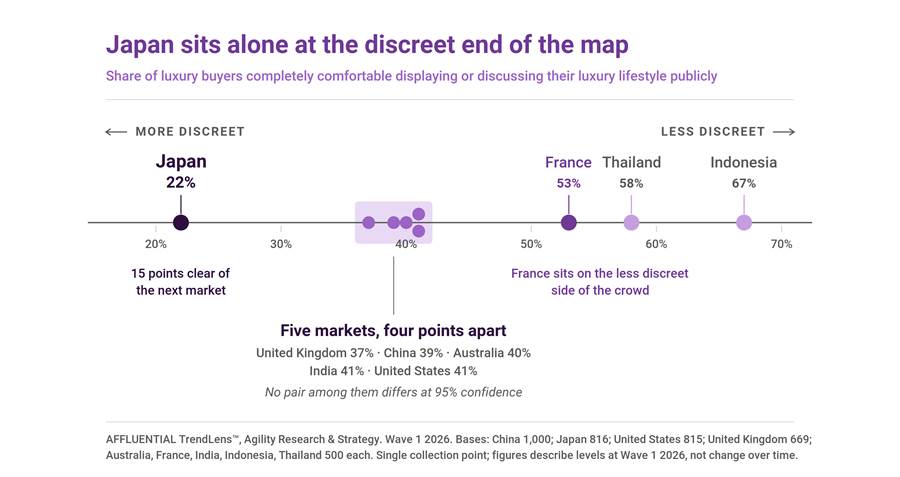
Japan sits alone at the discreet end of the map.
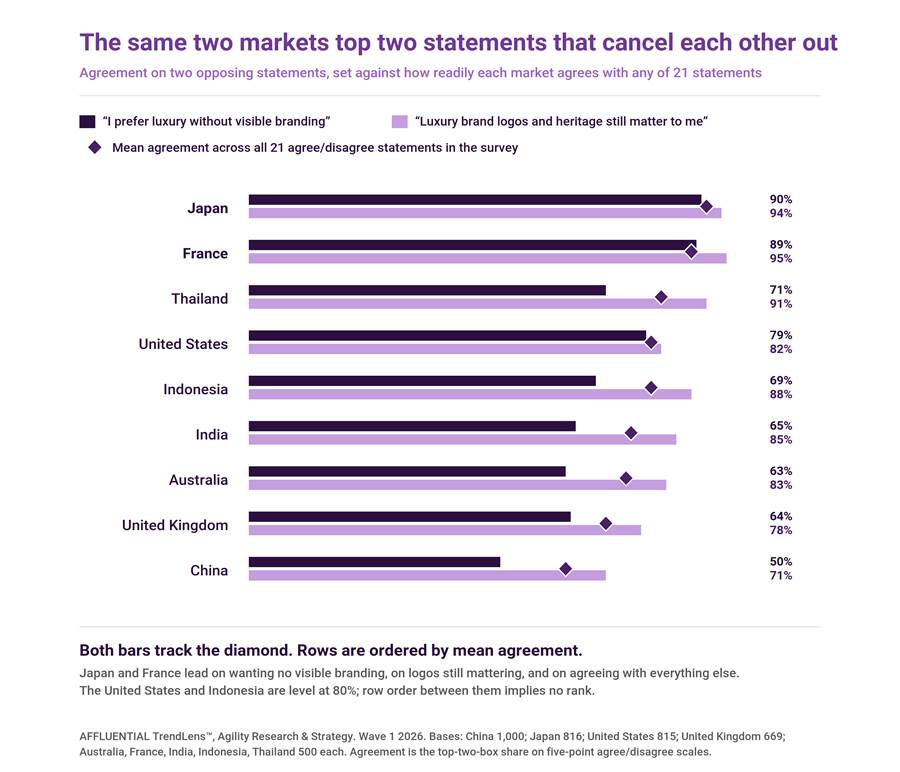
The same two markets top two statements that cancel each other out.
Source Note:
AFFLUENTIAL TrendLens™, Agility Research & Strategy. Wave 1 2026, nine markets, n=5,800. China n=1,000; Japan n=816; United States n=815; United Kingdom n=669; Australia, France, India, Indonesia, and Thailand n=500 each.