

Agility Research & Strategy has just released its latest study, 2026 Luxury Leaders Pulse. Gathering interviews with over 40 global C-suite executives from a variety of luxury sectors including Rosewood, Van Cleef & Arpels, Dior, Chanel and Harrods, the report provides insights on perceived priorities and challenges – and how they see the luxury sector evolve in the upcoming year.
Here are five key takeaways…
1. The luxury industry enters 2026 with cautious optimism
Luxury leaders are divided about the year ahead. Around 39% expect challenges, while 36% anticipate stability, suggesting a market navigating uncertainty rather than clear growth momentum. Only a smaller share sees strong opportunities or major disruptions, highlighting a broadly balanced but cautious outlook for the sector.
2. Business expectations are stabilising after a slowdown
Sentiment has rebounded slightly compared with 2025 but remains well below the post-pandemic highs seen earlier in the decade. About 45% of executives expect higher business performance in 2026, while another 47% expect results to be similar to 2025, reinforcing a view that the industry is shifting from rapid expansion toward a phase of disciplined growth and normalisation.
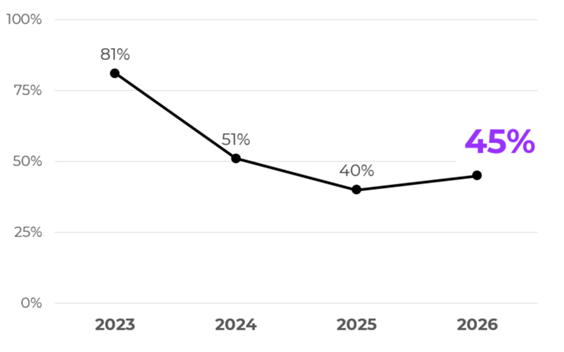
Sentiment shows a modest rebound, with 45% of luxury leaders expecting higher business in 2026 (versus 40% last year), but remains well below highs of 2023 levels (81%), pointing to a still-cautious outlook
3. Geopolitics and cautious consumers are the biggest risks
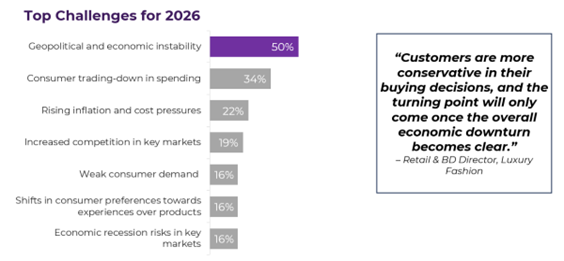
Luxury executives see macro uncertainty as the primary challenge for 2026. The top concerns include geopolitical instability, consumer trading-down behavior, and inflationary pressures, reflecting growing sensitivity to economic volatility and shifting spending priorities among affluent consumers.
4. Experiences are becoming the central growth engine
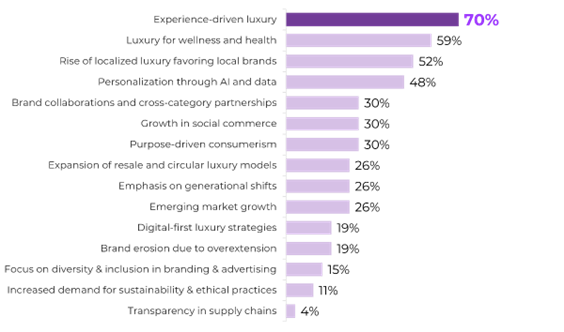
The industry continues to pivot toward experience-driven luxury, with 70% of leaders identifying experiential luxury as the leading trend shaping the sector. Wellness-focused luxury, localised brand positioning, and AI-enabled personalisation are also gaining momentum, signaling a shift toward holistic lifestyle engagement rather than product-centric luxury alone.
5. Marketing budgets are shifting toward immersive engagement
Luxury brands are reallocating marketing spend toward experiential and digital channels. Investments are increasing in consumer events, digital media, collaborations, and celebrity ambassadors, while traditional advertising and live-stream KOL marketing are declining, reflecting a strategic pivot toward high-impact brand experiences that drive deeper engagement and conversion.
If you would like more in-depth insights on affluent and HNW consumers across 35 global markets, with relevant data on luxury consumption, luxury trends and shopping patterns, please contact jason@agility-research.com for more information
Link: What do luxury leaders see as the opportunities and challenges for 2026? | The Walpole
“What do luxury leaders see as the opportunities and challenges for 2026?” courtesy of Walpole (April 16, 2026). © 2026 Walpole. All rights reserved.