


Two-thirds of affluent and high net worth consumers across nine markets say too many luxury brands have raised prices without improving quality. Yet when they rate the brand they last bought, 87% of ratings say good value. The grievance is real, and it lands on brands the buyer has not chosen.
Luxury buyers have a pricing complaint, and they aim it carefully.
In TrendLens 2026, 65% of affluent and high net worth respondents across nine markets agree that too many luxury brands have raised prices without improving quality. It is the majority view in all nine markets, from 51% of respondents in mainland China to 81% in Japan.
The brands those same buyers pay get a far warmer verdict.
Rating the brand behind their most recent purchase in each category they had bought, respondents called it good value in 87% of 11,461 ratings and overpriced in 2%. Even among the 3,750 respondents who agreed with the complaint, 82% rated every brand they had bought as good value.
The two results answer different questions.
One is a view of the category; the other is a verdict on a brand the buyer chose, and people tend to stand behind their own choices. Read together, they place the grievance precisely: it sits with luxury at large and rarely follows the buyer to the till.
Buyers hold both views at once
The complaint and the approval live in the same heads.
Asked about the luxury brands they currently buy, 82% of respondents agree those brands are still delivering value for the prices they charge, and 53% agree with that statement and with the complaint about rising prices. For most buyers, the two judgements sit side by side without friction.
Buyers also describe themselves as more careful.
Looking back two years, 81% say they are more selective about which luxury brands they spend on. That is a recalled change rather than one tracked over time, but it fits the pattern: buyers are sorting brands into the ones that have earned the price and the rest.
The ones that have earned it are, for each buyer, the ones already bought. That is what turns a category-wide complaint into a buffer for incumbents.
The pattern holds across groups that might be expected to differ.
Respondents with US$1 million or more in financial assets are slightly less likely to agree with the complaint (61%) than those with less (66%), and both groups rate their own brands as good value at the same rate, 87%.
Older buyers are the most critical of the category: 68% of respondents aged 50 and over agree with the complaint, against 62% of those under 35. Neither difference changes the shape of the finding. Every group condemns the category more than it condemns its own purchases.
Incumbents hold a buffer that challengers lack
For a brand that already has the buyer, the gap between category and brand works as protection.
Only 0.6% of brand ratings described the buyer’s own brand as significantly overpriced and said they were reconsidering their spend with it.
Buyers also make the case for the premium themselves.
A Singapore skincare buyer in a separate Agility interview study explained what separates expensive brands: “the more expensive products will invest more in R&D and they will use better material, better ingredients.” One account cannot size a view, but it shows the reasoning a satisfied customer brings to the counter.
A challenger brand gets none of that goodwill. Its prices are judged against the category, and two-thirds of buyers consider the category inflated. The same price that an existing customer explains away is, for a new one, evidence for the complaint.
Watches, handbags and perfume carry the thinnest margin
The buffer is uneven across categories. In wine and spirits, 90% of brand ratings were good value and 8% chose the middle answer, “prices are high but acceptable”.
Jewellery (89%), airlines (88%) and hotels and fashion (87% each) sit close behind. In watches, good value falls to 80% and the middle answer rises to 19%, more than twice the wine and spirits share. Handbags (81% good value) and perfume (79%) sit close to watches, with 17% in the middle answer for each.
Outright dissatisfaction stays rare everywhere. The highest overpriced shares, in perfume and skincare, are 4%. The pressure shows up instead in the middle answer: a buyer who pays the price without endorsing it.
The survey records that view rather than what the buyer does next, but it marks where a further increase would be tested first.
Markets set the backdrop for that test.
The 30-percentage-point range in agreement with the complaint, from 51% in mainland China to 81% in Japan, means the same price list lands on very different levels of scepticism. A brand pricing in Tokyo faces a market in which four in five buyers already believe the category has overreached, even if its own customers rate it as well as customers do in Shanghai.
Two practical readings follow.
First, category-level price sentiment is a poor forecast of a brand’s own churn: the buyer who agrees that luxury has overreached is, in the same survey, rating the brand they chose as worth the money. Second, the measure worth tracking is the middle answer in a brand’s own customer base, because that is where the benefit of the doubt thins before it turns into the complaint. A brand can see that drift in its own client research long before it shows up in sales.
For a watch brand, the exposure is specific: one rating in five of its own buyers already sits at “high but acceptable”, the answer closest to the complaint those buyers aim at everyone else.
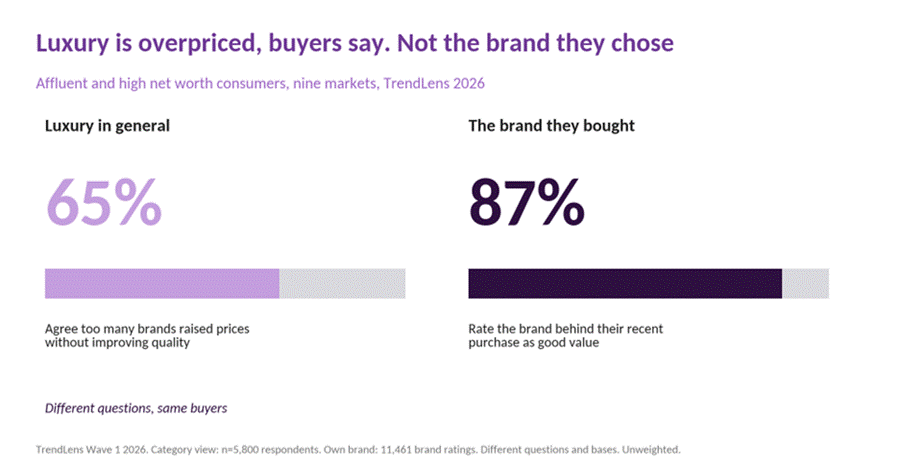
Alt text: Two panels: 65% of affluent and high net worth consumers say too many luxury brands raised prices without improving quality; 87% of ratings of the brand they last bought say it is good value.
Source note
AFFLUENTIAL TrendLens, Wave 1 2026, n=5,800 affluent (under US$1 million in financial assets) and high net worth (US$1 million or more) respondents in China, Japan, the United States, the United Kingdom, India, Indonesia, Thailand, Australia and France. No weighting applied. Category view: “Too many luxury brands have raised prices without improving quality” (VALUEGAP r2), agree or strongly agree. Own-brand view: “Do you currently feel [brand] offers good value for the prices it charges?”, asked for the brand of the most recent purchase in each category; good value = “Yes, strongly” or “Yes, broadly”; base 11,461 brand ratings. The two questions use different bases and the second is selection-favourable. Selectivity (VALUEGAP r3) is a recalled comparison. Verbatim: separate Agility qualitative study (Singapore), English original, anonymised. Body: 898 words.