

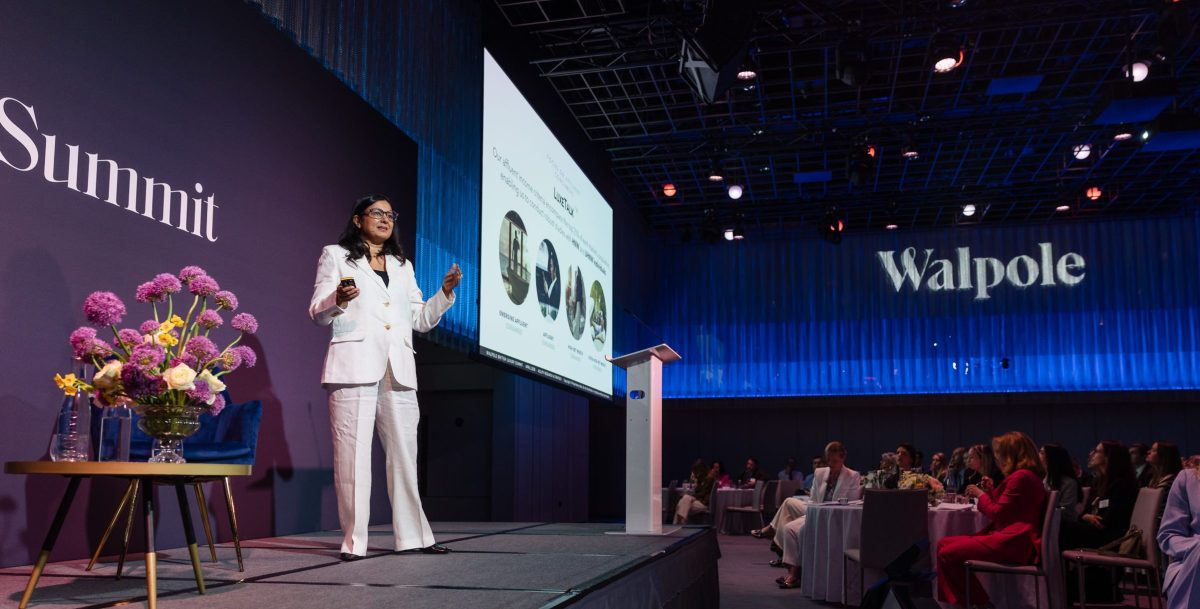
The Walpole British Luxury Summit brought together the leaders shaping the future of one of Britain’s most powerful industries.
Our Managing Director, Amrita Banta, presented global trends among ultra-high net worth consumers, exploring what it means to stay relevant to a luxury customer who has it all. Drawing on proprietary data from our LuxeTalk™ UHNW community and our TrendLens™ research programme, she made the case that the industry is debating the wrong question. The choice between heritage and experience is a false binary. What the most valuable luxury consumers really want is meaning, and the brands that earn it will hold them for a generation.
“Luxury is not what you sell. Luxury is a presence. Not in every room, in the moments that define a life.”
Amrita Banta, Managing Director, Agility Research & Strategy
Agility Key Takeaways for Brands
Five Themes
Across a day of sessions, five themes emerged with consensus. What follows is our read of those themes, informed by our own UHNW research and what we heard directly from Burberry, Selfridges, Aston Martin, Fortnum & Mason and others on the day.
01 – From Transaction to Emotion: The New Architecture of Luxury
The most consistent message of the day was also the most urgent: luxury brands built for transaction are being left behind by brands built for feeling. The new architecture has three layers: sensory (what you see, touch, hear), social (who is in the room with you), and emotional (how this makes you feel about yourself and the people you love). When all three are present, brands earn the loyalty that price alone can never manufacture.
Joshua Schulman at Burberry put it in practical terms. The brand had drifted into a disconnect between its creative and commercial functions. His fix was not a rebranding. It was a realignment. The shift from ‘modern British luxury’ to ‘timeless British luxury’ was not a tagline change, it was a signal to the consumer: we know what we stand for.
At Selfridges, the same logic is reshaping retail itself. The business now runs over 850 pop-ups and 600 events annually. One third of its 3.5 million loyalty members are under 30. The loyalty programme rewards time spent in store, not just money spent. That is a fundamental philosophical choice: we want a relationship, not a receipt.
02 – Luxury Service: Invisible service not White Glove
Something interesting is happening at the top of the market. White-glove service, once the definitive signal of luxury, is increasingly read as stuffy or performative by younger affluent consumers. And yet, impeccable service is still a baseline expectation. The differentiator has shifted.
03 – Gen Z is Rewriting the Rules for Everyone
Gen Z is not a segment to target. They are a value system that is recalibrating the entire luxury market. Their priorities, authenticity over aspiration, craft over badge, ethics alongside aesthetics, are not generational quirks. They are the direction for luxury consumers of all ages.
04 – AI is Restructuring How Luxury is Discovered
The AI session was among the most commercially urgent of the day. The core finding: luxury searches on Google are declining. Discovery on large language models is rising sharply. This is not a future risk. It is happening now.
Around 60 to 65 percent of consumers already use AI in fashion discovery and purchase. The discovery journey is now: search on an LLM, refine and personalize, and increasingly, complete the purchase, all without leaving that environment.
05 – The UHNW Consumer is Driving the Market. Brands Are Still Catching Up.
The luxury market has lost approximately 20 million aspirational consumers. Margins are back at 2009 levels. But the segment that is holding, and in some categories growing, is the UHNW.
For UHNW, Luxury is an ecosystem, not a product. luxury is woven into daily life through seamless service and the freedom to spend time entirely on their own terms.
Our research consistently shows that UHNWs are not trading down, they are trading inward. Stability, inner peace, freedom and meaning outrank status and logo visibility.
For more Insights on our Walpole Presentation, get in touch with jason@agility-research.com