


More than four in five affluent and high net worth consumers across nine markets call wellness spending a high or top priority, led by Thailand and Japan. Their interest spreads almost evenly across ten wellness areas, which leaves no single product, retreat or service owning the territory.
Wellness clears a bar few luxury priorities reach.
In TrendLens 2026, 84% of affluent and high net worth respondents across nine markets call spending on wellness products and services a high or top priority in their lives, and 35% put it at the very top.
Respondents in Thailand lead at 94%, followed by Japan (91%) and France (88%); even the lowest markets, mainland China and the United Kingdom, reach 77%.
The priority does not vary with wealth.
Respondents with US$1 million or more in financial assets (85%) and those with less (84%) rank wellness high at almost exactly the same rate. Wellness, for these buyers, is no marker of a particular tier.
Age matters more than wealth at the top of the scale. Among respondents aged 50 and over, 38% call wellness their top priority outright, against 35% of those aged 35 to 49 and 30% of those under 35.
The intensity rises with age even though the overall priority is shared.
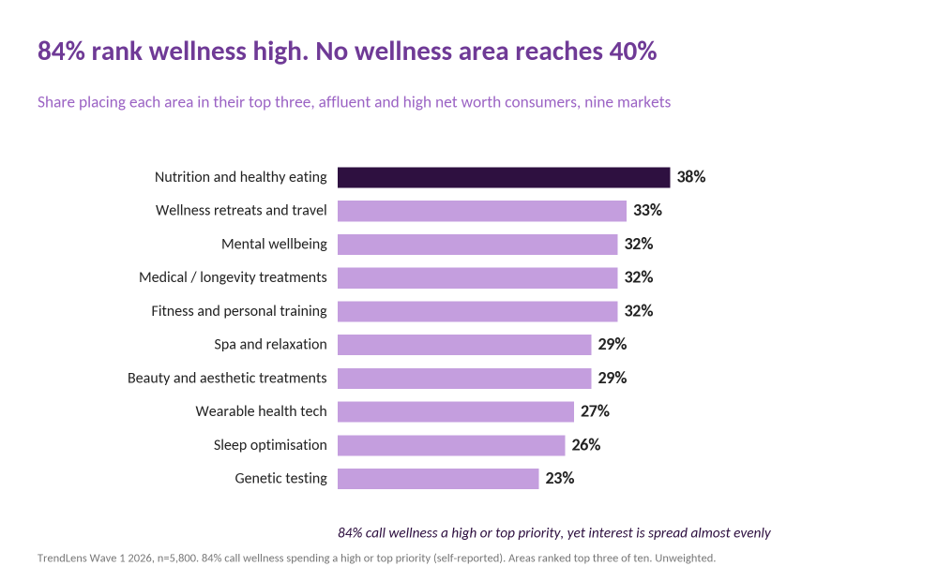
Agreement ends there. When respondents ranked the wellness areas they most want to spend on, their choices spread almost evenly across ten options. Nutrition and healthy eating services appear in the most top-three lists, at 38%.
Wellness retreats and travel (33%), fitness and personal training (32%), medical and longevity treatments (32%) and mental well-being (32%) follow closely, and genetic testing and precision health come last, at 23%. Every area except the first and last falls between 26% and 33%.
The wealthier group leans slightly further toward clinical options.
Medical wellness and longevity treatments appear in the top three of 34% of respondents with US$1 million or more in financial assets, against 31% of those with less, and 21% of the wealthier group name long-term health and longevity as their main motive, against 19%. The differences are small, but they run in the same direction.
That combination is the commercial puzzle.
Wellness matters to nearly every buyer, yet no single wellness purchase commands even two in five of them, and a priority stated in a survey is not the same as money spent.
Buyers describe wellness as upkeep
The reasons respondents give point to daily life more than to occasions.
A quarter (25%) say their main motive for wellness spending is feeling healthier day to day, and a further 19% name long-term health and longevity. Enjoying premium or exclusive experiences is the main motive for 14%, and reducing stress and improving mental well-being for 13%. Looking better (12%), staying competitive in a career (10%) and preventing serious illness (7%) complete the list.
A Singapore skincare buyer in a separate Agility interview study described her own spending in the same terms: “I’m pretty happy to spend it on maintaining my skin”. Maintenance, bought often, sits closer to her account than indulgence.
Taken together, 45% of respondents give a health motive, day to day or long term, as their main reason.
That is the core of the wellness market as these buyers describe it: a steady expense in service of feeling well, closer to a household routine than to a special purchase.
Experiences carry the strongest pull
Where wellness does work as an occasion, it competes well.
Among twelve types of luxury experience beyond travel, wellness immersion, such as multi-day private spa programmes or retreats, is the one most respondents find appealing (31%), ahead of exclusive entertainment and private fine dining (28% each).
Travel shows how thinly the interest spreads even there.
A wellness and well-being focus appears in more respondents’ top three luxury travel motivations than any other, at 30%, but culinary tourism matches it at 30% and personalized service and cultural immersion follow at 29%. Wellness leads by a margin too small to build a travel portfolio on.
Wellness works as a standard more than a category
Read together, high priority, scattered interest and everyday motives suggest that buyers apply wellness as a test to what they already buy: a hotel stay, a skincare routine or a menu can pass or fail it.
The survey does not measure that test directly; the reading rests on the pattern.
Market intensity varies sharply.
In Thailand, 64% of respondents call wellness their top priority outright and in Japan 43%, against 24% in mainland China and 22% in the United Kingdom. The same wellness claim will read as essential in Bangkok and as one consideration among several in London.
The pattern sets a different brief for different businesses.
For a hotel group, the retreat programme is the most appealing experience format on the list, yet the leading motives guests give are everyday ones. For a beauty or fashion house, the motive is maintenance, which favours products and services bought regularly over one-off treatments.
A hotel group that answers with a standalone retreat competes for a slice of interest no wellness area holds above 38%.
The motive most respondents give, feeling healthier day to day, is one that every room, menu and routine on its existing property either serves or ignores.
Source note
AFFLUENTIAL TrendLens, Wave 1 2026, n=5,800 affluent (under US$1 million in financial assets) and high net worth (US$1 million or more) respondents in China, Japan, the United States, the United Kingdom, India, Indonesia, Thailand, Australia and France. No weighting applied. Priority: WELLNESSPEND (high or top). Areas: WELLPRIORITY (top three of ten). Motivation: WELLNESSMOT (single choice of seven). Experiences: EXPERIENCE_TYPE (multiple choice of twelve). Travel: TRAVEL_MOTIVATE (top three of eleven). Priority is self-reported salience, not spend; “a standard across categories” is the article’s interpretation. Verbatim: separate Agility qualitative study (Singapore), English original, anonymised. Body: 830 words.