

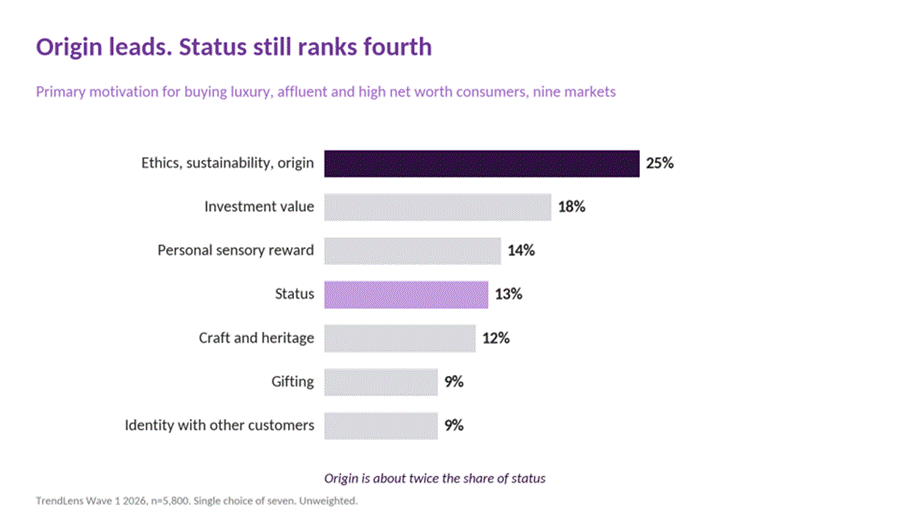
A quarter of affluent and high net worth consumers across nine markets buy luxury primarily on ethics, sustainability and authenticity of origin, the largest single group and about twice the share driven by status. The proof they want is a document they can check.
The single most common reason wealthy consumers give for buying luxury is about origin and conduct.
In TrendLens 2026, a quarter (25%) of affluent and high net worth respondents across nine markets chose this as their primary motivation: “I choose brands based on their ethical credentials, sustainability practices, and authenticity of origin. I want to know where things come from and whether the brand stands for something I believe in.”
Status keeps its place on the list.
Valuing items that others recognize as symbols of success is the primary motivation for 13%, fourth of seven, behind investment value (18%) and luxury as a personal sensory reward (14%), and ahead of craft and heritage (12%), gifting (9%) and identifying with a brand’s other customers (9%).
The origin motive is about twice the size of status, 12 percentage points ahead.
A Singapore skincare buyer in a separate Agility interview study described the personal side of that choice: “I’m not going to buy luxury just to follow the mainstream. It’s unless something I truly love.”
The motive comes with a commercial edge.
Among respondents whose primary motive is origin and ethics, 70% say they are likely to spend more over the next year with the brands in the luxury category they focus on most, against 65% of all respondents, and 26% say they are very likely to, against 21%. The largest motive group is also one of the most willing to keep spending.
Wealthier buyers lean further toward origin
The pull is stronger higher up.
Among respondents with US$1 million or more in financial assets, 33% name ethics, sustainability and authenticity of origin as their primary motivation, against 23% of those with less, a gap of 11 percentage points. Both groups choose status at similar rates, 12% and 13%. The difference in motive sits almost entirely in origin; display draws both groups equally.
What the wealthier group gives up is the investment rationale.
Investment value is the primary motive for 16% of respondents with US$1 million or more in financial assets, against 19% of those with less.
Age moves the origin motive less: 23% of respondents under 35 choose it, against 26% of those aged 35 to 49 and 26% of those aged 50 and over. Wealth, more than age, is what sharpens the demand for provenance.
Most markets follow the pattern.
Respondents in the United States (32%) and India (30%) choose the origin motive most often, followed by Indonesia (29%), mainland China (27%) and Thailand (27%).
The United Kingdom (24%), Australia (22%) and Japan (20%) sit lower, yet origin is still the most-chosen motive in each of them.
France is the clear exception.
Only 13% of respondents in France choose the origin motive, and investment value leads there at 25%.
A brand that leads on provenance everywhere will find its strongest audience in New York and Mumbai and a much weaker one in Paris.
Buyers want proof they can check
Respondents also chose the single factor that would most convince them of a brand’s commitment to longevity and ethics in their main luxury category.
The two leading answers are both evidence of where a product comes from: public disclosure of every supplier in the production chain (18%) and a digital product passport proving origin, materials and ownership history (16%).
The next tier is about the life of the product.
Materials from biodiversity-restoring sources convinced 14%, a brand-led platform to resell or recycle items 13% and a guaranteed lifetime repair and restoration service 12%.
At the bottom, investment in removing the carbon footprint of the buyer’s own use convinced 3%, and audited proof of local environmental restoration 6%.
Only 8% say none of these would change their view.
Respondents who buy primarily on origin choose the same leading proofs as everyone else: supplier disclosure and the passport together account for 32% of their answers, as they do across the sample.
The demand for check-able evidence is not confined to the most committed group.
Related measures point the same way.
In the same survey, 86% of respondents say they value brands that preserve traditional craftsmanship, 86% say they would pay more for a luxury item they believe will outlast their lifetime, and 71% say they prefer luxury without visible branding.
Agreement with statements like these runs high across the survey, so they are best read as direction, not as precise sizes.
Authenticity is a disclosure task
That makes authenticity something a brand has to show.
The proof buyers ask for is a document they can inspect: a supplier list, a passport attached to the piece, a repair and ownership record.
Campaign language about values sits nowhere on the list of what would convince them.
A brand that cannot show its supplier chain or a passport for the piece is asking the largest group of luxury buyers, and a third of the wealthiest, to take its origin on trust.
Source note
AFFLUENTIAL TrendLens, Wave 1 2026, n=5,800 affluent (under US$1 million in financial assets) and high net worth (US$1 million or more) respondents in China, Japan, the United States, the United Kingdom, India, Indonesia, Thailand, Australia and France. No weighting applied. PHILOSOPHY (single choice of seven); origin option quoted in full in the body. SUSTAIN_INTEGRITY (single choice of ten). BRANDTRUST, SOCIAL_SENTIMENT r1 and r3, LEGACY r4 (agree). Status is fourth, never last. Verbatim: separate Agility qualitative study (Singapore), English original, anonymised. Body: 818 words.